





At Bright Little Stars, we started our ICT initiative as we wanted all children to have the best start in their digital education. Technology is everywhere and children are growing up in a more technologically advanced world, meaning they need to be prepared for jobs that haven’t even been created yet. Our ICT Lead, Sophie, trained as a VFX artist in London, working for some of the leading companies in the industry. That experience showed her how quickly the world of technology changes, and how important it is to introduce these skills early.
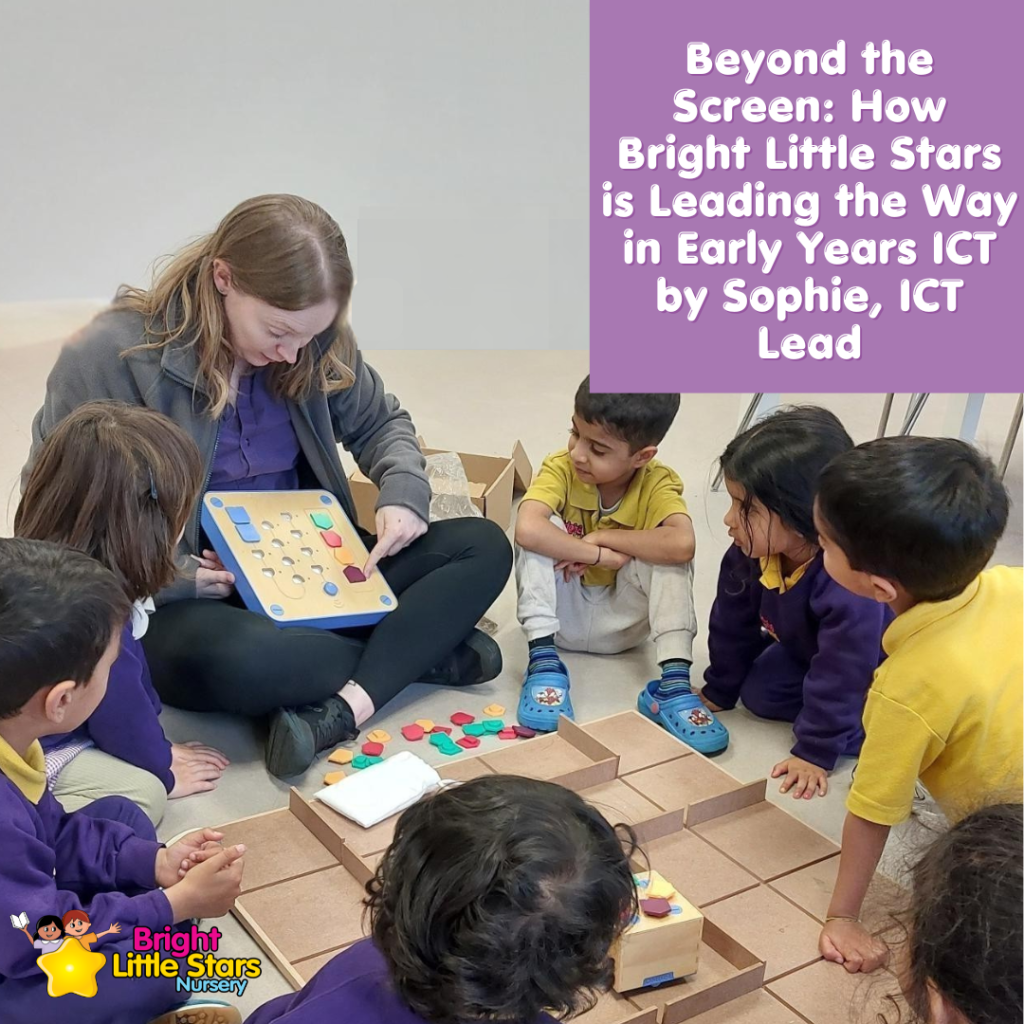
Initially, we introduced the children to Cubetto and stop motion animation. The idea was to give them early experiences of coding and animation skills. Very quickly, we realised how many other areas of learning were being developed through this too. To code, children are using maths, communication and language, and problem solving. To animate, they are using storytelling skills and creativity. These are skills children already have, but they’re not always linked to technology in a purposeful way.
From there, we began to explore more apps and programmes. One of our favourites is ChatterPix. It allows children to bring their pictures to life. They draw a picture, add a mouth, record their voice, and suddenly they’ve created a talking character. We’ve seen even our most energetic boys completely engaged in this for long periods of time.
We also use Canva, which helps bring children’s imagination to life in a different way. With the use of AI features, children can describe a character and see it created visually. This really supports storytelling and encourages them to think about using descriptive language in a meaningful way.
Some of our nurseries also have interactive sensory projectors. These allow children to engage with educational games while developing gross and fine motor skills. Our SEN children especially enjoy this resource. It promotes inclusive play, allowing all children to access the same resource but achieve different learning outcomes from it.
Of course, it is important to highlight not all technology or ICT skills need a screen, or an app. Computational thinking is just as important. Training such as Barefoot Computing has helped our staff understand that coding skills can be taught anywhere. Talking about direction on walks, sequencing events, spotting mistakes in patterns, and giving instructions all help build the foundations for coding. These everyday experiences support algorithmic thinking, debugging, and logical reasoning without children even realising it.
We also use remote-controlled cars, cause and effect toys, and torches. These are simple resources that naturally support early computing skills and are used every day by children and staff without it always being labelled as “technology”.
ICT also supports our practitioners. Tools such as TeachMate help generate ideas and support planning, as well as thinking about how to extend activities in an age-appropriate way. It is there to support practice, not replace it.
Looking ahead, we envisage continued development in our use of technology, including exploring AI and potentially introducing robotics or VR experiences. VR, in particular, is growing quickly and could allow children to experience places around the world in an immersive way. The focus will always remain the same though: technology should enhance learning and support practitioners, not replace the important interactions that happen every day in the room.